Friday, May 14
Athens city walk-You’re never more than a few steps away from the past in Athens. Accompany your Tour Director to the Plaka, the historic district that borders the Acropolis. In its twisting narrow streets, you’ll catch glimpses of an older city, from wrought-iron balconies bursting with geraniums to traditional Greek dancing in basement tavernas. Continue to the Temple of Olympian Zeus, begun in the 6th century B.C. and finished in A.D. 132 by the emperor Hadrian. Its enormous columns provide a sense of the scale of the original temple. Nearby, the elaborate Hadrian’s Arch separated the ancient and imperial sections of the city.
Hadrian’s Arch-View Hadrian's Arch, an enormous triumphal arch built by the Roman Emperor Hadrian, which is still a symbolic entrance to Athens.
Saturday, May 15
Athens guided sightseeing tour-Not just another crowded dusty city, Athens has developed from the birthplace of democracy to a bustling modern metropolis. With a local licensed guide, start your time travel at the ancient hot spots of the first Olympic site and the sprawling Acropolis, classical Athens’ religious and civic center. The awe-inspiring Parthenon -- a temple dedicated to Athens’ patron saint Athena -- is the obvious centerpiece, but take time to examine the building next door, where sculpted women hold up the roof with their heads, and the amazing view of modern Athens below. Jump back to the present in Syntagma Square, the center of the modern city, to see the Parliament building and the British-style changing of the guards ceremony. (There’s a rather un-British flair to it, however -- the Greek guards wear white skirts, head scarves, and shoes and knee bands adorned with pom-poms.) Continue to Omonoia Square, Athens' other main meeting point, to relax by the splashing central fountain ringed with olive trees.
Acropolis site visit-Visit the Acropolis, which has overlooked Athens for over 2,000 years; habitation traces indicate that it was occupied as early as the Neolithic Age. View the Temple of Athena Nike, and its successor, The Parthenon. The Parthenon is the crowning achievement of the Doric order, built to demonstrate the wealth of Athens in tribute to its patron goddess, Athena.
Syntagma Square-Syntagma Square, located directly in front of the Old Royal Palace, is the central square of Athens.
Sunday, May 16
Delphi guided excursion-Explore the impressive ruins at Delphi, which the Greeks considered the center of the world. Within the depths of the Temple of Apollo, a priestess would inhale intoxicating vapors that used to rise from the earth and, thus inspired, deliver the prophecies of Apollo. Modern visitors might find more inspiration in the view from Mount Parnassus, over 8000 feet high.
Monday, May 17
Depart Athens on four-day Aegean cruise-Island hop, Aegean style! This four-day cruise will take you to six of the most beautiful islands in the world, all with a unique look and feel. There are more than 160 inhabited Greek islands, and they comprise one-fifth of Greece, and should not be omitted from any visit to this beautiful country. Your first port of call is Mykonos, with museums, white, cubistic buildings, Crayola-colored boats, gourmet restaurants, and lots of beaches.
Mykonos visit-Now one of the most popular of the Aegean islands, Mykonos is rugged and beautiful at the same time and is one of the smallest islands of the Cyclades – it’s only 10 miles long and 7 miles wide. Mykonos is absolutely picturesque - thatched windmills, whitewashed streets, and a medieval quarter boasting cubic houses with picturesque balconies, and churches with red or blue doors. You can walk along the main shopping street, Matoyanni, and search for jewelry and clothing, or just take a break in one of the cafes that line the street. You’ll also visit the capital, Hora, with its colorful harbor in which little fishing boats nest happily side by side with luxury yachts.
Tuesday, May 18
Kusadasi and Patmos visit-Next stop on the cruise is Kusadasi, known for its myriad of shops and historic sites. The Kusadasi excursion includes a trip to ancient Ephesus. From there it’s on to seahorse-shaped Patmos. Patmos is a barren island and is the home of the famous Monastery of St. John the Theologian. There are only 2,500 lucky inhabitants of this rocky but beautiful island, and they are mostly concentrated in three towns – Skala, Chora and Kambos. Many people come here to pay religious homage, while wealthy Athenians and Europeans use this island as a vacation destination. You’ll see gold-leafed Byzantine frescos at the Monastery of St. John, the picturesque village of Chora, and Skala, the busy port town with many beautiful beaches, shops, and much else to keep you busy – all found on this beautiful and picturesque island.
Wednesday, May 19
Rhodes visit-Rhodes offers tiled-roofed gazebos, huge trees, open-air plazas, old towns with whitewashed streets and buildings, and of course, beaches. Once a political and religious center of the ancient world (and home of one of the seven wonders of the ancient world), Rhodes now lures visitors with sunny beaches, well-preserved medieval fortifications, and a castle on a hill. A league of Christian knights built the beautiful palace in the 1300s on the highest point of the island. Though partially destroyed by an explosion in 1856, the palace was rebuilt by the Italians to serve as one of Mussolini’s summer homes.
Thursday, May 20
Crete and Santorini visit-Visit Heraklion, the capital of Crete, a former Minoan seaport with Venetian architecture and the largest collection of Minoan archaeology. The Heraklion excursion includes the Minoan Palace of Knossos, which is the 1st European Civilization. The largest city on Crete and the fourth-largest city in Greece, Heraklion holds many treasures from the past within its modern buzz. The central Archaeological Museum proudly displays the remains of Heraklion’s Minoan heritage. Walk around and explore the many churches and ancient ruins, or just shop the markets and sample wonderful Greek fare. And finally, you’ll visit Santorini, where whole villages seem to cling to the side of the volcano, and mysterious black sand beaches stretch into the sea. The Santorini excursion includes the spectacular Oia Village perched on the caldera rim. Rising steeply from the Aegean, crescent-shaped Santorini marks the rim of a volcanic crater that exploded in 1625 B.C., destroying and fragmenting a much larger island. The sea flooded into the crater, and now white towns gleam from the tops of the rocky cliffs, streaked black, brown, pink, and pale green. Rumors claim that this island may actually be the not-so-lost Atlantis.
Friday, May 21
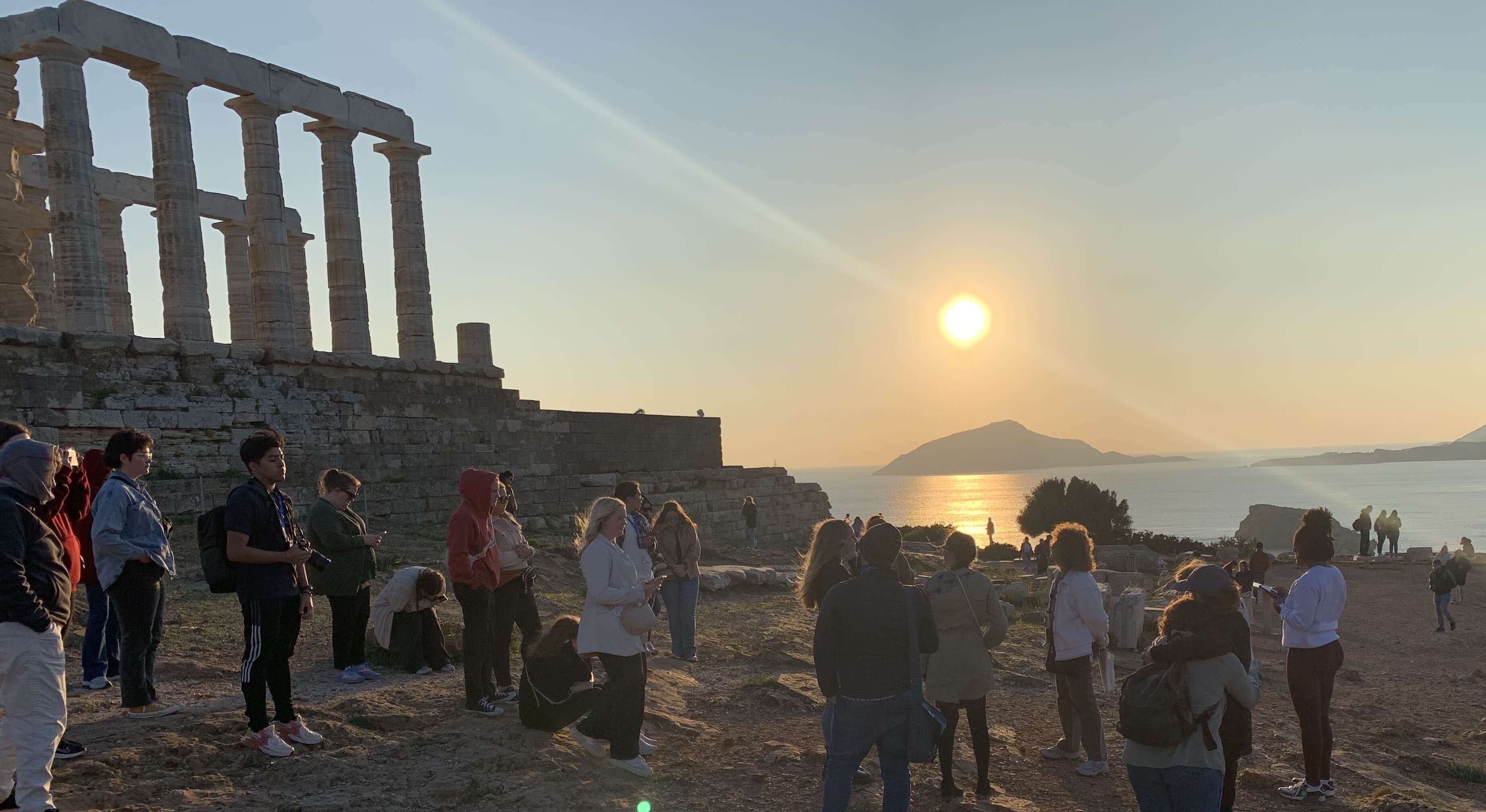
Sounion guided tour-Depart from the cruise in Athens to a private bus that will travel to Sounion. Contemplate the sea god Poseidon from his temple perched high atop the hill of Cape Sounion, the southern-most tip of Central Greece. Stand among the tall, marble pillars rising up from the slippery slabs of rock and look out over the calm blue Aegean Sea. The Temple of Poseidon, built around the same time as the Parthenon (between 450-440 BC), is a refreshing point of calm after the chaos of modern Athens. Return for the evening to Athens before starting an excursion the following day to London, England.
Saturday, May 22
London city walk-Step outside your hotel for a stroll through the heart of the English-speaking world. In this city of nearly seven million, you'll see everything from 12th-century fortifications to modern skyscrapers, royal parks to street art. Your Tour Director will lead you to some of the most famous sites. Walk along the Thames River. Cross Trafalgar Square (often used for community gatherings and political demonstrations). Visit the National Gallery, which contains an unrivaled collection of Western art spanning seven centuries, from the late 13th to the early 20th. The largest portion of the collection is devoted to the Italians, including works by da Vinci, Titian, Veronese, Tintoretto and Botticelli; but the collection also features works by the Spanish giants El Greco, Goya and Velázquez. The Flemish-Dutch school is represented by Brueghel, Jan van Eyck, Vermeer, Rubens and Rembrandt; and there is also an immense French impressionist and post-impressionist collection that includes works by Manet, Monet, Degas, Renoir and Cézanne. See bustling Piccadilly Circus, a shopping and entertainment area brightly lit with video displays and neon signs. Pass trendy shops and cafés in Bohemian Soho on your way to Covent Garden, a 13th-century fruit and vegetable garden transformed into a maze of narrow streets and pedestrian walkways burgeoning with street performers, open-air markets and boutiques. Covent Garden is a district in London, on the eastern fringes of the West End, between St Martin's Lane and Drury Lane. It is associated with the former fruit and vegetable market in the central square, now a popular shopping and tourist site, and with the Royal Opera House, which itself may be referred to as "Covent Garden". The district is divided by the main thoroughfare of Long Acre, north of which is given over to independent shops centered on Neal's Yard and Seven Dials, while the south contains the central square with its street performers and most of the historical buildings, theatres and entertainment facilities, including the London Transport Museum and the Theatre Royal, Drury Lane. Enjoy Leicester Square, which is perfectly situated in the heart of London's West End, with Trafalgar Square to the south, Piccadilly Circus to the west, Covent Garden to the east, and China Town to the north. Finish the day with British than fish and chips—there are eight fish and chip shops (“chippies”) for every McDonald’s in the country. Head to an authentic pub with your Tour Director for a taste of this national food, generally served with malt vinegar.
Sunday, May 23
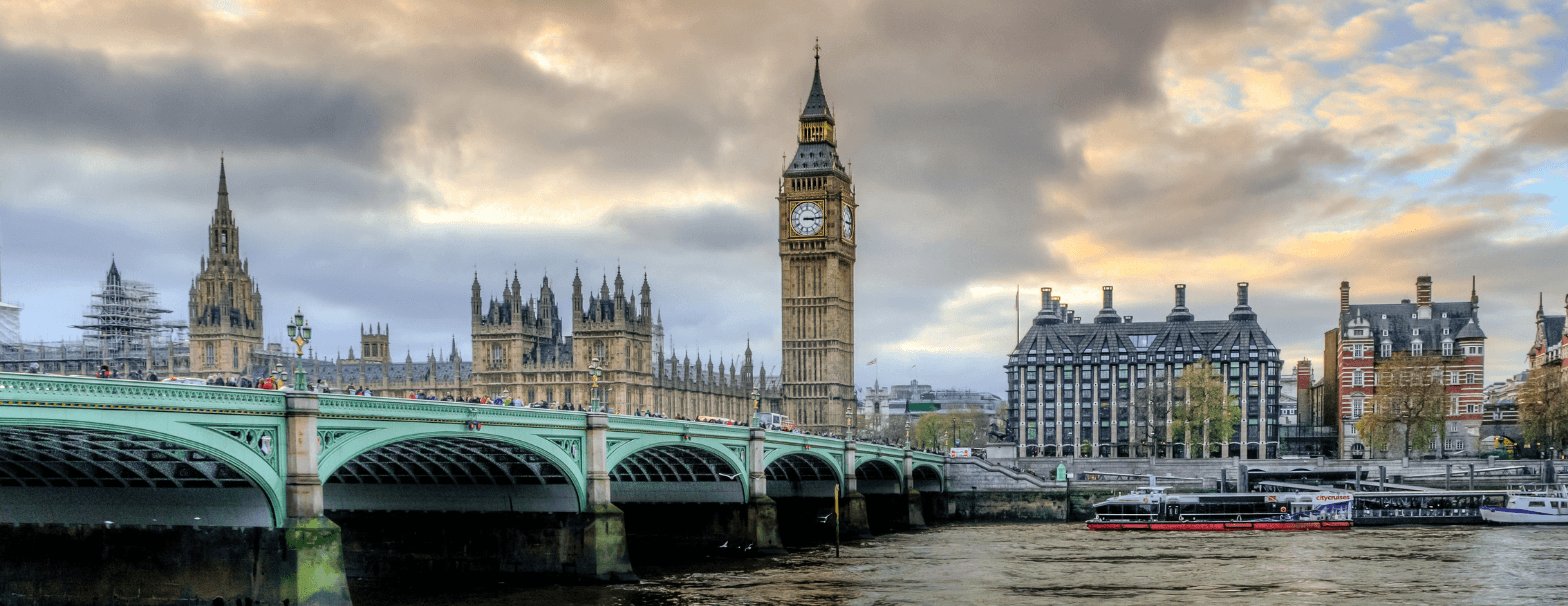
London guided sightseeing tour-Join a licensed local guide for an in-depth look at London, from the royal haunt of Buckingham Palace (the official London residence of King Charles III) to the slightly more democratic Speakers’ Corner of Hyde Park, where anyone can pull up a soapbox and orate to his heart’s content. You’ll see the changing of the guard (season permitting), the clock tower of Big Ben with its 14-ton bell, and Westminster Abbey, where almost every English king and queen since William the Conqueror has been crowned. After a stop at the Houses of Parliament, continue on to the magnificent St. Paul’s Cathedral, the masterpiece of London architect Christopher Wren.