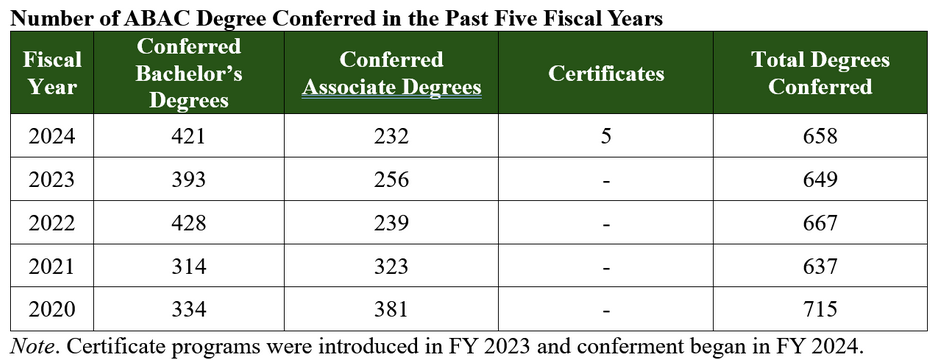
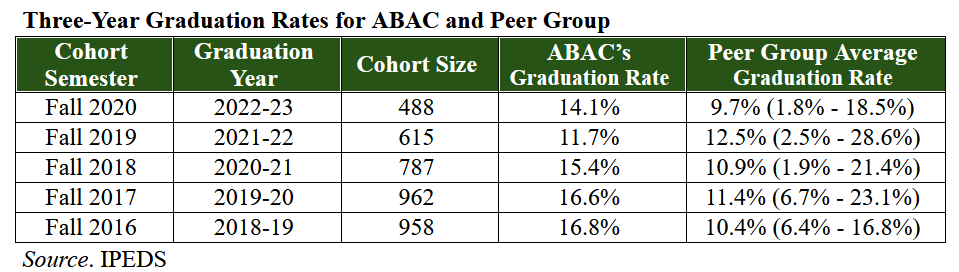
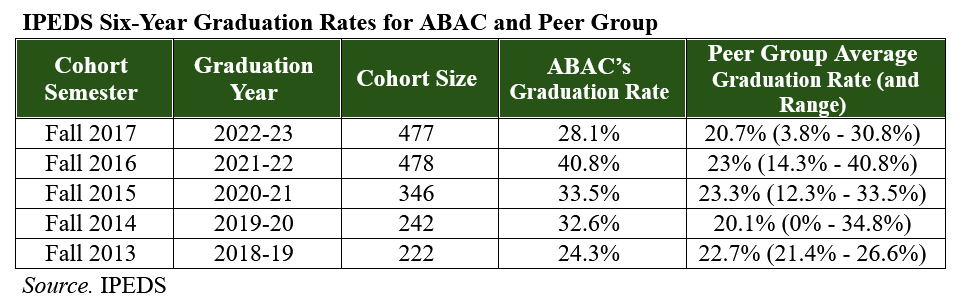
ABAC’s goal or threshold for acceptable performance for its six-year graduation rates is to exceed the average graduation rate of ABAC’s comparison peer institutions (other USG State Colleges). ABAC annually monitors its six-year baccalaureate graduation rate of first-time, full-time degree-seeking students as a measure of the success of its degree programs. The data below are for pre and post-consolidated ABAC.
The data in the table below shows that ABAC has continually achieved its threshold of acceptability goals with respect to the peer group average. There was a dip in ABAC’s graduation rate between the fall 2016 and the fall 2017 cohorts of 12.7 percentage points; however, the rate was still above the average of the comparison peer institutions. Additionally, ABAC continues to be on the upper end of the graduation rate range for USG State Colleges (peer group) and exceeds the peer group average for the fall cohorts presented below.
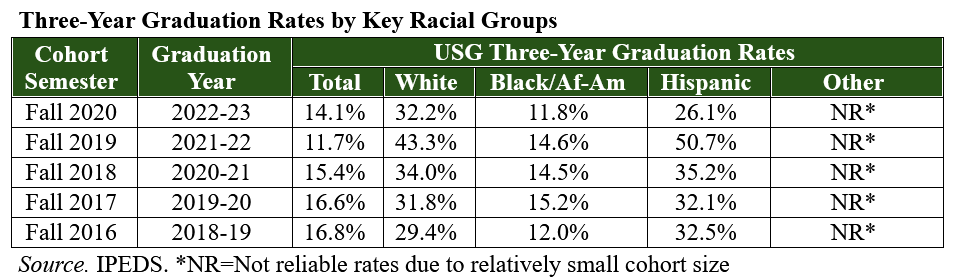
The SACSCOC 2019 Interpretation of CR 8.1 also stipulates that institutions should disaggregate their graduation data by appropriate student demographic categories in order to identify student populations that may be at risk of having low graduation rates. Racial group differences are often studied in the USG when retention and graduation rates are under review, so a disaggregation of ABAC’s six-year graduation rates by racial group is particularly appropriate. Below are the disaggregated graduation rates by key racial student groups.
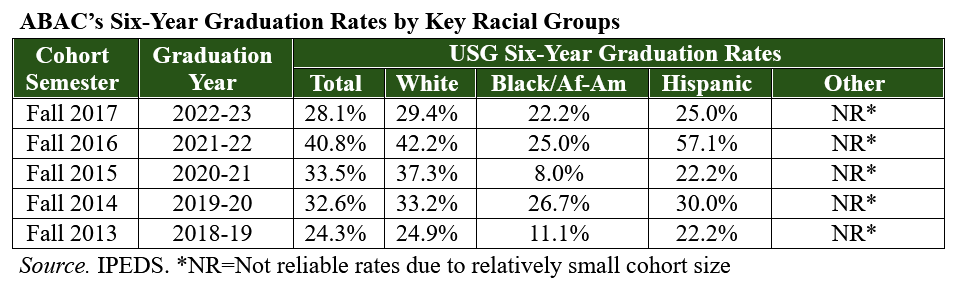
Looking closely at the cohorts from fall 2013 through fall 2017, there is a concern in these disaggregated data that Black/African American and Hispanic student populations are more at-risk for lower graduation rates at ABAC than their White peers. The graduation rates for Black/African American and Hispanic student populations have risen sharply from Fall 2015; however, there is room for improvement.
Although the initiatives described above to improve graduation rates, in general, involve all racial groups equally, additional institutional strategies are underway that look at closing the identified achievement gaps. In 2025, ABAC underwent a deep data review through the National Institution for Student Success to identify four key challenges to scaling student success. Implementation of the NISS Playbook begins in 2026, with several of the recommendations focused on programs and interventions that provide assistance to ABAC’s most vulnerable and disadvantage students.
Additionally, in September of 2025, ABAC was awarded a 1.3 million dollars TRIO Student Support Services Grant (SSS). ABAC last had the TRIO SSS grant in 2009. The TRIO SSS grant is designed to help first-generation, low-income, or students with disabilities persist and graduate. Monies from the grant will assist at least 140 students who meet the TRIO SSS eligibility and is expected to positively impact graduation rates among our most at-risk students.